
"AI will not replace humans, but those who work with AI will replace those who do not."
MDPO professors, alumni, students, and professionals reflected on the strategic use of artificial intelligence in organizations.
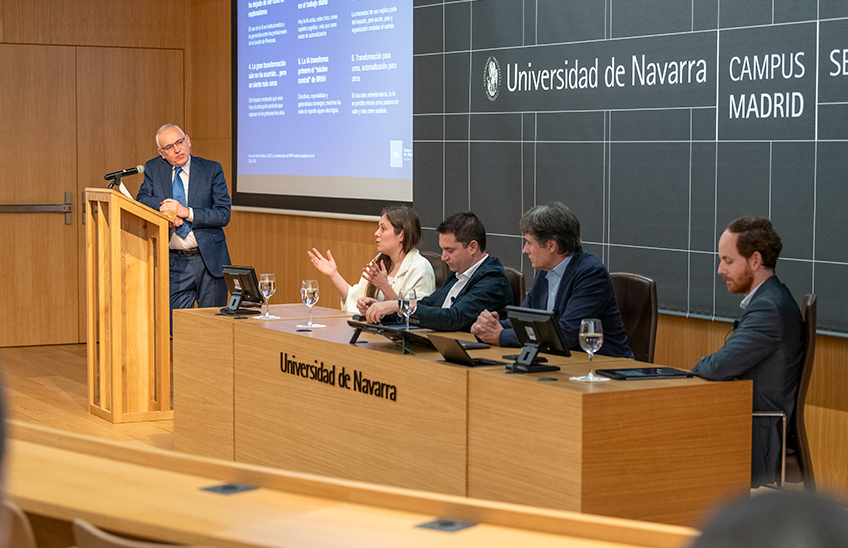
Photo courtesy of: From left to right: José Antonio Alfaro, Tina Estrada, Guillermo Lorbada, Santi García, and Íñigo Calabuig.
09 | 03 | 2026
Artificial intelligence is no longer an isolated experiment but has become an increasingly integrated tool in the daily work of companies. What seemed like a conversation about the future just a few years ago is now becoming astrategic reality for organizations. These were some of the conclusions of the meeting that brought together professors, students from the Master's Degree in People Management in Organizations (MDPO), and professionals from the world of human resources at the University of Navarra's postgraduate headquarters in Madrid to reflect on Artificial Intelligence and its impact on human resources management and processes. "AI is not going to replace humans, but those who work with AI will replace those who do not," they agreed.
This event brought to a close the week dedicated to new ways of working organized by the MDPO for its students. The session, moderated by Professor José Antonio Alfaro, focused on the challenges facing Human Resources in the face of artificial intelligence and featured the participation of Guillermo Lorbada ( Head of New Ways of Working at Repsol), Íñigo Calabuig ( Head of Group HR Transformation Office at Verisure), Tina Estrada (Digital Learning & Innovation Lead at NTT Data) and Santi García (Founder of Future for Work Institute). During the meeting, they shared specific experiences on how their organizations are integrating artificial intelligence into people management.
One of the clearest messages of the day was that artificial intelligence does not replace human judgment, but rather amplifies its impact.
Today, it is increasingly used in tasks such as writing, data analysis, and information searches, saving time and improving process quality, although the major transformation of the role of HR is yet to come.
The speakers agreed that the real challenge is not technological, but organizational and cultural. Companies will have to decide what role they want AI to play in their workforce and how to integrate it responsibly, safely, and in line with their strategy.
Beyond technology, the speakers highlighted the skills that will make a difference for professionals in the future: adaptability and curiosity to explore new ways of working; critical thinking to take responsibility for decisions even when AI is involved; empathy and human relations, which will continue to be the real differentiator in organizations; and communication and creativity, from knowing how to ask good questions to imagining new solutions.