
From Nature to the Cross: Gaudí’s Universe in the World’s Tallest Church
Professor Asunción Domeño is analyzing the symbolism of the church at the University of Navarra; this year marks the centennial of its creator, and the church will be visited by Pope Leo XIV
26 | 05 | 2021
The Basilica of the Sagrada Familia is full of fascinating facts, such as the fact that its angels have no wings and are sculpted in the likeness of Barcelona residents. Or that the donkey from the Flight into Egypt couldn’t be just any donkey and ended up being Margarita, a restless donkey that had to be hoisted with pulleys to cast the sculpture. It could also be said that, as of February of this year, it is the tallest church in the world, at 172.5 meters, or that it has been under construction for 144 years.
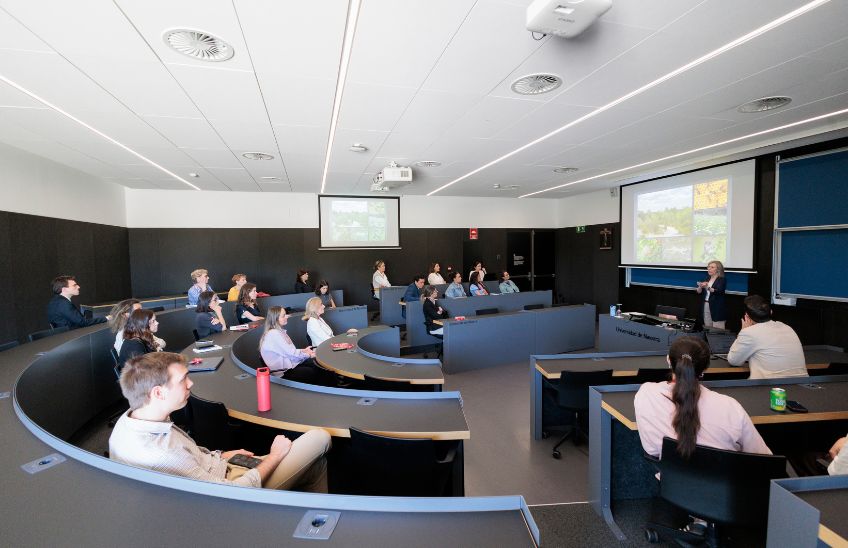
What is widely known, however, is that the Sagrada Familia was Antonio Gaudí’s most important work, as Professor Asunción Domeño of the Faculty of Philosophy and Letters at the University of Navarra explained during a session on the Madrid campus. The architect devoted forty-three years of his life to a project that this year—marking the centennial of his death— will receive the blessing of Pope Leo XIV during his visit to Spain.
On June 10, the pontiff will visit Barcelona to bless the Tower of Jesus Christ, which crowns the temple with a large cross that Gaudí described as follows: “The central tower, taller than all the others, will be topped by a four-armed cross, from which rays of light will emerge that, on the nights of great solemnities, will trace a cross in the sky…” The architect wanted the whole world to look up to the sky and find in it a message of hope.
During this visit, Asunción Domeño provided an overview of the life of Antonio Gaudí, “one of the leading figures of Spanish Modernism,” and the masterpiece he envisioned: the Sagrada Familia. “He knew he wouldn’t have time to finish it, but he conceived it with that in mind and left behind numerous models and drawings,” the professor noted.
Barcelona presented an “opportunity” for Neo-Gothic and Modernist architects in the mid-19th century. The city, which until then had been “constrained by walls, with a medieval layout that prevented it from expanding outward,” began to grow beyond those walls: “It was undergoing significant industrial development, had experienced a cultural renaissance, and had embarked on an ambitious urban expansion project.”
“Antonio Gaudí came from a family of artisans and always showed great affection and respect for manual labor,” Domeño noted. Furthermore, “he was a sickly child, and during his periods of convalescence, when he was encouraged to take walks, he grew accustomed to observing and analyzing nature: the wings of birds, the life cycles of plants, tree trunks…”
“Faith, the earth, and nature are the pillars of Gaudí’s universe,”stated the art history professor, who noted that for Gaudí, “beauty is the radiance of truth.” In the cathedral, the architect incorporated some of the geometric formulas he had used in other works. He had inherited the project, as the commission had initially been undertaken by Francisco de Paula del Villar y Lozano, which forced him to build based on a rather uninnovative floor plan; “though he knew how to give it a new approach and reorganize the iconographic programs.”
Gaudí drew inspiration from nature when designing the basilica, which is why its interior resembles a forest, with columns that evoke trees and a ceiling that evokes a starry sky. He also used color as a narrative element and constantly played with symbolism.
“The tower that has just been crowned on the Sagrada Familia—the tallest one—is dedicated to Jesus Christ and surrounded by the four towers of the evangelists. There is another dedicated to Mary. The twelve portals represent the apostles, and the 20 columns represent the universal church,” explained Domeño, who analyzed details depicted on the altarpieces and exterior portals, such as those wingless angels, since “if God had taken the form of a man, the angels could not be any different.”
“Angels playing classical, religious, and secular music,” explained the professor. “Gaudí wanted it to have a realistic quality and to speak to the faithful.” That is also why they photographed local residents by name to inspire the sculptures, depicted perfectly identifiable plants such as the olive tree, the laurel, the papyrus, and the lotus flower, and sought out hens, roosters, geese, ducks, turtles, owls, and Margarita the donkey. “At the Sagrada Familia,” recalled Asunción Domeño, “all of nature celebrates the birth of Christ.”